What does a paver patio cost in Hampton Roads?
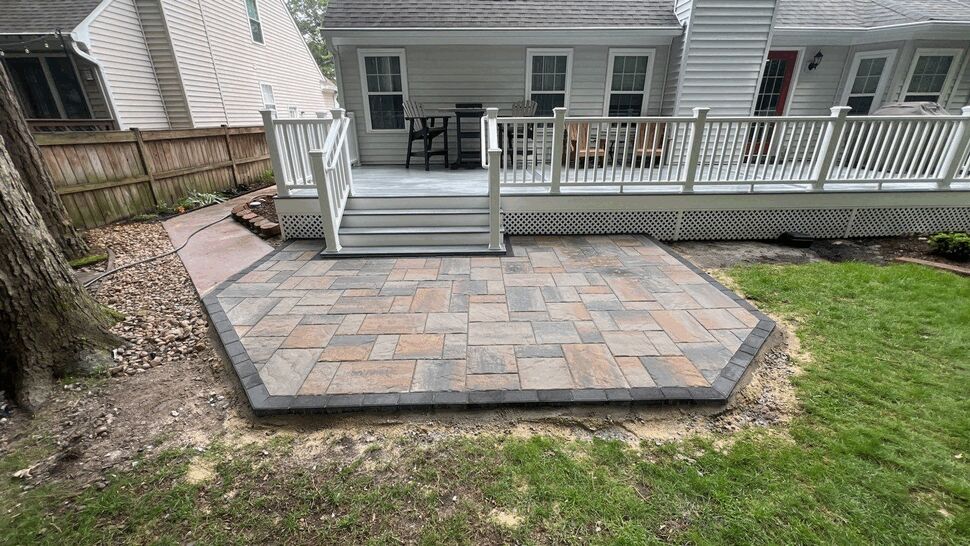
A paver patio runs roughly $8 to $25 per square foot installed, putting a typical 300 square foot patio between $2,400 and $7,500. Concrete pavers sit at the lower end, clay brick in the middle, and natural stone at the top. In this market the base is the cost variable people underestimate. Sandy soil and a high water table mean the excavation and aggregate below the pavers does more work than the pavers themselves.
Paver patio cost by size and material
What moves the number: base depth required by the soil, grading and drainage work, whether a retaining or seat wall is included, cutting and pattern complexity, and access for equipment.
Installed ranges are national averages current September 2026; no published Hampton Roads paver dataset exists. Your written estimate is the binding number.
What goes under a paver patio in Tidewater
A paver patio is a drainage system with a decorative surface. Get the base wrong and the surface tells you within two winters: settling, rocking pavers, standing water, and joint sand washing out.
Hampton Roads makes that harder than most markets. The region takes about 40 inches of rain a year, August alone averaging around 4.4 inches. Much of the soil is sandy with a water table close to the surface, and a lot of newer subdivisions sit on fill. All of that argues for a deeper compacted aggregate base than a builder would use inland, compacted in lifts rather than all at once, with the grade pitched to move water away from the house rather than into the crawl space.
The second Tidewater-specific issue is where the water goes. Pitching a patio away from the foundation is not enough if it dumps onto a neighbouring lot or into an area already prone to ponding. On lots near water we look at this at design, not at the end.
- Compacted aggregate base in lifts, depth set by soil conditions, not a standard number.
- Grade pitched away from the foundation and toward a planned outlet.
- Polymeric joint sand and edge restraint, which is what keeps the field tight over time.
- Coordination with existing downspouts and any French drain.
Permit note: Permit requirements can change by locality, structure and environmental overlay. Exterior Source confirms current city and HOA requirements before construction.
Paver patio questions
Pavers or a poured concrete slab?
Pavers cost more up front and are repairable. A settled section is lifted and reset, and individual units are replaced. A poured slab is cheaper and cracks, and in this region's soil, it will crack. Pavers also move with minor settlement instead of fracturing.
How long does a paver patio take?
Most 200 to 400 square foot patios are three to six working days on site, weather permitting. Excavation and base compaction take the majority of it.
Will weeds grow through the joints?
Polymeric jointing sand and a properly compacted base make it uncommon. Where weeds appear it is usually organic debris settling on top of the joints rather than growth from below.
Can a patio go right up against the house?
Yes, provided it is pitched away from the foundation and does not bridge the siding or block a weep or vent. On a lot with existing drainage problems, that is a design conversation before it is a construction one.
What's the best time of year to install one here?
March to May and late September to November. August combines peak humidity, the wettest month of the year and the ramp into peak hurricane activity, and base compaction in saturated soil is a losing proposition.
Do you do walkways, driveways and retaining walls too?
Yes. Walkways, driveways, steps, seat walls and retaining walls are usually specified together so the base and drainage are designed once.
Get a written paver patio estimate
We'll walk the lot, check where water already goes, and give you a written fixed-price estimate.
Explore all outdoor living services.
Last updated September 2026.